
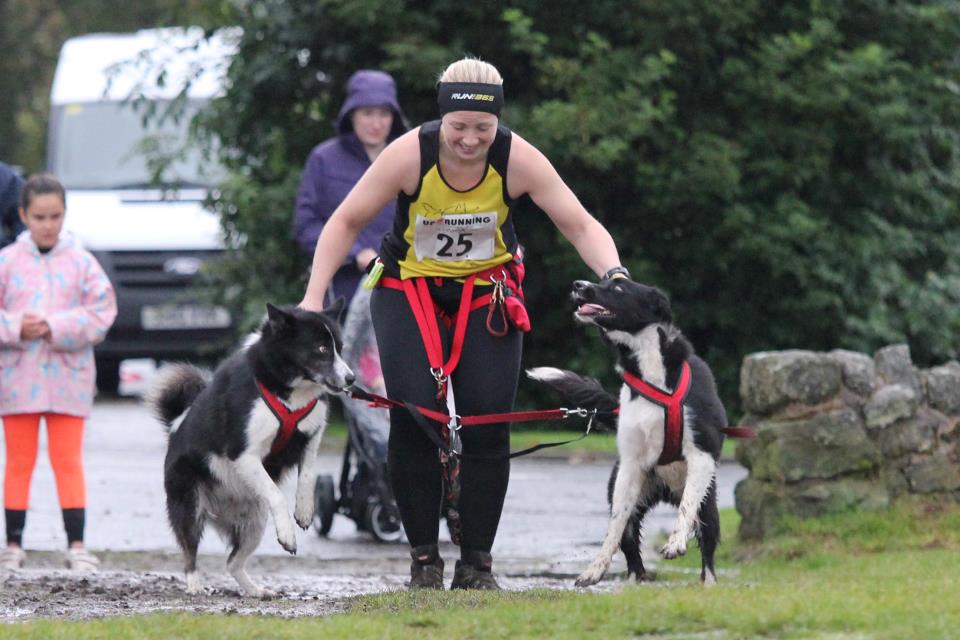
March is Pet Anxiety Month so it felt like a good time to write this blog on running with a reactive dog. Many of the people who get into the dog sports of canicross, bikejor and dog scootering, do so because they have a high-energy dog, possibly bred to do a job which isn’t accessible to them in their current home. Some of these dogs are rescues, and some have just developed anxiety, leading to the dog being reactive in certain situations. I know plenty of people who have a found a safe haven in canicross because it allows you to exercise your dog, whilst keeping them close to you and under control to prevent incidents with other dog walkers.

People who have never owned a reactive dog will probably not understand the daily struggles of planning a stress-free route for your dog or the impact that their ‘friendly’ off lead dog interfering can have on your dog and your day. So whilst it is extremely annoying, we do all have to consider that not everyone will understand your dog’s reaction and often their first response is to accuse you of having an aggressive dog – not fun, or fair on anyone!
I want to point out that I’m not a qualified behaviourist, I talk about this from my own experiences having owned three reactive dogs now, all of whom were reactive in slightly different ways and for different reasons and all of whom I have canicrossed with and canicross raced with.
In my experience, dogs become reactive for a reason, and whatever that reason is, it is usually based on a fear of something. If you can find out what ‘triggers’ their reactivity (so basically work out what is frightening them) then you are halfway there to helping ease, or resolve, the problem.
Of course, we also have to rule out reactivity being caused by pain, and this is something I also have a lot of experience with now through my role as a canine therapist. The first thing that needs to be explored with any ‘reaction’ your dog may have to situations, is to ensure there is no associated pain. That might be done through a vet visit, it might be through an initial assessment with a therapist. However you choose to rule out pain, it should be the first consideration.
My own dogs
The first example I have is with my first canicross dog Tegan. Tegan was a husky collie cross, with loads of energy and being a mix of two renowned working breeds, both endurance breeds with a really strong work ethic, she was always going to be determined. This is important because Tegan NEVER gave up on something if it upset her, if she had a ‘run in’ with another dog, she would remember that and it was very difficult to persuade her not to react in any future meetings with that dog, I think her persistence in this was part of her genetic make up, not just as a result of an individual disagreement.

Tegan would react badly to most dogs she saw whilst on the lead and holding her in situations where we met other dogs ‘head on’ was always difficult. Canicrossing however, was a different story, and I couldn’t understand at first why she was fine running shoulder to shoulder with a strange dog, yet would create merry hell in the car park after a run if the dog came any where near her. I began to learn about what situations ‘triggered’ her reactivity and so I would avoid them if at all possible.
Avoidance of the trigger has now become my key tool in dealing with reactivity, and you might be thinking ‘well that’s not really an answer that solves the problem’ but for my dogs and me, it is. Tegan would react because she felt threatened in a situation, not because she was a nasty, aggressive dog, but because she genuinely felt that, for whatever reason, she was unsafe in meeting some other dogs in head on situations and so she would react first.
My springer collie cross Donnie was similar, he would happily canicross alongside a dog he has never met before but if you asked him to ‘meet’ a dog in a walking or running situation, he turned into a spitting, snarling and quite frankly scary-looking dog. I often found myself apologising for him if we met someone out on walks or runs, and I generally left the encounter embarrassed, which is why more often than not, I just used to try to avoid meeting people altogether.

Where it’s not possible to avoid coming face to face with other dogs, I had to do my best to ensure every situation was managed and didn’t lead to something which could reinforce the behaviour. So staying calm, moving him as far out of the way as possible and reassuring him, were generally the methods I employed to help keep him below his ‘threshold’ for reacting.
Canicross was a lifeline for us in that I knew I had him under control when he was attached to me, and I could pull him in closer to me quickly. He was also generally a much happier dog than if he were constantly in a situation where he was reacting to everything. The other thing about Donnie was that he had Addisons Disease, which is influenced by stress and so keeping him as stress-free as possible quite literally kept him healthier!
My final example dog is Delta, who is much quieter and more subtle with her reactivity, but she is still nervous and whereas Tegan and Donnie’s reactions were your typical ‘fight’ response to a potential threat, Delta’s is flight, so she runs! This is where canicross comes into the picture again for being a great way for her to see the countryside with me but without her being in a situation where she feels the need to flee. Delta knows she can just drop by my side and I can keep other dogs / people away, and so her confidence has grown since we have been canicross training, as she learns that nothing bad happens when she’s with me and I wrote another blog on this here: https://k9trailtime.wordpress.com/2020/01/27/keeping-your-dog-safe/ about making sure she felt safe.

So what happens when you go to a canicross race?
Canicross racing is something I have written a fair bit about but not necessarily in the context of the reactive dog. I often see people ask if they can take their reactive dog to a canicross race and the short is answer is ‘yes’. The longer answer however, is, ‘yes, but think very carefully about whether you should’.
I am always actively encouraging people to get to canicross races, the organisers are people generally experienced with dogs and will be friendly and understanding towards you, even if you dog is reactive. Most true dog people understand that not all dogs will behave in the same way and will help you feel welcome and try and accommodate any worries you might have about taking part in a canicross race.
However, and this is quite a big however, if you feel your dog won’t cope very well with the situation being surrounded by other high energy and excited dogs, or having to pass other dogs and this might cause your dog more stress than enjoyment, or worse put your dog in a situation where you feel they have the potential to harm another dog, you or even themselves, then perhaps a race situation isn’t for you.

You do need to be able to control your dog in a race situation so that you are not responsible for causing anxiety in someone else’s dog. I’ve been on the receiving end of this and have had my dogs lunged at and ultimately put off racing by other competitors’ lack of care when handling their dog in a race. I personally wouldn’t want my dog to be the cause of this for someone else, and so I would always recommend building your reactive dog up slowly to racing. If you positively train them around other dogs, taking time to reinforce the fun elements of running with other dogs and work hard to do all you can to make the experience exciting rather than anxiety-inducing, then you can enjoy racing with your reactive dog too.

My final thoughts
So to conclude, running with your reactive dog can be a really good way to get your dog used to being around other dogs without putting them under too much pressure to interact, or allow them to reinforce any negative behaviours around other dogs and people. Whether your dog is confrontational when anxious or looks to escape the situation, you have much more control if your dog is attached to you and can give you the peace of mind you need to be able to enjoy going out with your dog, without the fear of a negative situation with other trail users.
Happy trails!


Love this article! Really resonates with me and my journey with Bramble. I love running with him/other dogs and he is fine running in a pack.
I also understand the worry of Addisons- our last boy had Addisons and even though it was controlled from aged 8 to his passing aged 16 we were always worried about undue stress (luckily he wasn’t reactive at all, super placid!)
Thanks for an interesting read ?
So glad you like it, Addisons is a big part of our lives now and I have to consider everything in our environment just in case!
Anybody got experience of running with a reactive that’s not aggressive, just VERY boisterous? My lad can’t go off lead but gets very frustrated when seeing other dogs. He just wants to greet them and leaps around like a hooligan, often growling (trust me, it’s not a nasty growl). If he’s able to greet the other dog he’s fine and calms down. He’s a Saluki and a typical sight hound – nothing else exists, not me, not treats, nothing except what he’s interested in.
It would be interesting to hear others experiences with similar dogs.